Guides / Pricing
Vietnam shrimp tariffs in 2026: what a US importer pays on top of the product price
October 29, 2026
A US importer of Vietnam frozen shrimp pays no ordinary customs duty on the product, but it pays three other charges at entry: an anti-dumping cash deposit that depends on the exporter, a countervailing duty and, since 24 July 2026, a 12.5 percent Section 301 duty. This guide, written as of October 2026, shows each layer, the source behind it and how the layers add up on a real invoice. Rates changed twice this year, so treat every number as dated and confirm it with a customs broker before you sign a contract.
The four layers on one entry
| Layer | Rate | Who it depends on | Source |
|---|---|---|---|
| Base (MFN) duty | Free | Nothing | US tariff schedule, 0306.17.00 and 1605.21.10 |
| Anti-dumping cash deposit | 4.28 to 25.76 percent | The exporter named on the entry | Commerce final results, February 2026 |
| Countervailing duty | 2.84 percent in the 2024 final determination | The exporter | Commerce, October 2024 |
| Section 301 forced-labor duty | 12.5 percent | The country of origin | USTR notice, July 2026 |
The base duty is the easy part. The US tariff schedule lists “Other shrimps and prawns” under 0306.17.00 and the breaded or other prepared shrimp lines under 1605.21.10 and 1605.29.10 with a general rate of “Free”. Everything that follows is on top of that zero.
Anti-dumping: the rate follows the exporter
The anti-dumping order on frozen warmwater shrimp from Vietnam dates from 2005. Commerce reviews it every year, and each review resets the cash deposit that importers pay at the border. Two reviews matter now.
Review of February 2023 to January 2024 (final results, 23 February 2026). Commerce assigned 25.76 percent to the two mandatory respondents, Soc Trang Seafood and Thong Thuan, using adverse facts available because it could not verify their data. Its cash deposit rate for those two is 25.46 percent after a subsidy offset. The other 22 exporters with a separate rate got 4.58 percent, or a 4.28 percent cash deposit. Any Vietnamese exporter without a separate rate falls into the Vietnam-wide entity at 25.76 percent. The notice lists 146 companies in that group.
Review of February 2024 to January 2025 (preliminary results, 13 May 2026). Commerce found 10.76 percent for the Fimex group, 6.30 percent for STAPIMEX and 7.56 percent for the non-examined companies that hold a separate rate. These are preliminary. Commerce said it intends to issue final results within 120 days of publication unless it extends the deadline, and extensions are common. No final results had been published as of 10 October 2026. The final numbers become the new cash deposit on the day they are published.
Two practical points follow from this.
- The exporter name on the invoice sets your deposit. Two processors in the same province can carry a 4.28 percent deposit and a 25.76 percent deposit. Before you price a container, ask the processor for its exact legal exporter name and check it against the appendices of the latest Commerce notice. A trader or a second exporter in the chain can change the rate.
- Do not let the supplier pay your duty. Importers must certify that they have not been reimbursed for anti-dumping duties. The Commerce notice warns that a failure to file the certificate can lead to a presumption of reimbursement and the assessment of double antidumping duties. If you buy on a delivered duty paid basis, ask your broker how the certificate works before you agree to it.
Cash deposits are an estimate. Commerce sets the final rate after each review, and the importer pays or recovers the difference when entries liquidate, often years later. Keep that open item in your cash plan.
Countervailing duty: a smaller layer
In its final countervailing duty determination of 28 October 2024, Commerce set a subsidy rate of 2.84 percent for STAPIMEX and for all other exporters, and 221.82 percent for Thong Thuan based on adverse facts. The 2026 anti-dumping notice shows how the two interact: it reduces the anti-dumping cash deposit by an offset for export subsidies, which is why 4.58 percent becomes a 4.28 percent deposit. We did not confirm the current countervailing cash deposit for each exporter, so ask your broker for the deposit that applies on your entry date.
Section 301: the new 12.5 percent layer
The Supreme Court ruled on 20 February 2026 that the president lacked authority to impose tariffs under the International Emergency Economic Powers Act, which ended the earlier reciprocal tariffs. A temporary 10 percent surcharge under Section 122 took effect on 24 February and is limited by law to 150 days. USTR then replaced it with duties under Section 301 after a forced-labor investigation of 60 economies. The notice, published on 28 July 2026, applies from 12:01 a.m. Eastern time on 24 July 2026.
For Vietnam the rate is 12.5 percent on all products except those on the exemption annexes. USTR put 17 economies at 10 percent, including India, Ecuador and Indonesia, which are Vietnam’s main competitors in the US shrimp market. Vietnam is not on that list.
Whether shrimp is exempt is the question that matters. The annexes in the Federal Register are published as images, so they cannot be searched as text. Trade press reporting on a Southern Shrimp Alliance summary says shrimp in all forms is covered and that USTR rejected importer requests to exempt seafood. Treat that as a strong signal, then have your broker confirm the exact tariff line, for example 0306.17.00 for frozen raw shrimp or 1605.21.10 for prepared shrimp, against the annex.
The notice also says that products it covers remain subject to antidumping, countervailing and other duties, so the 12.5 percent comes on top of the cash deposits above.
Timing matters. The duty applies to goods entered on or after 24 July. The carve-out covered only goods already loaded on the vessel and in transit before that moment and entered before 28 July. Today the entry date, not the ship date, sets the rate.
Ready to price this spec? Get matched with a shrimp supplier
What a container costs: a worked example
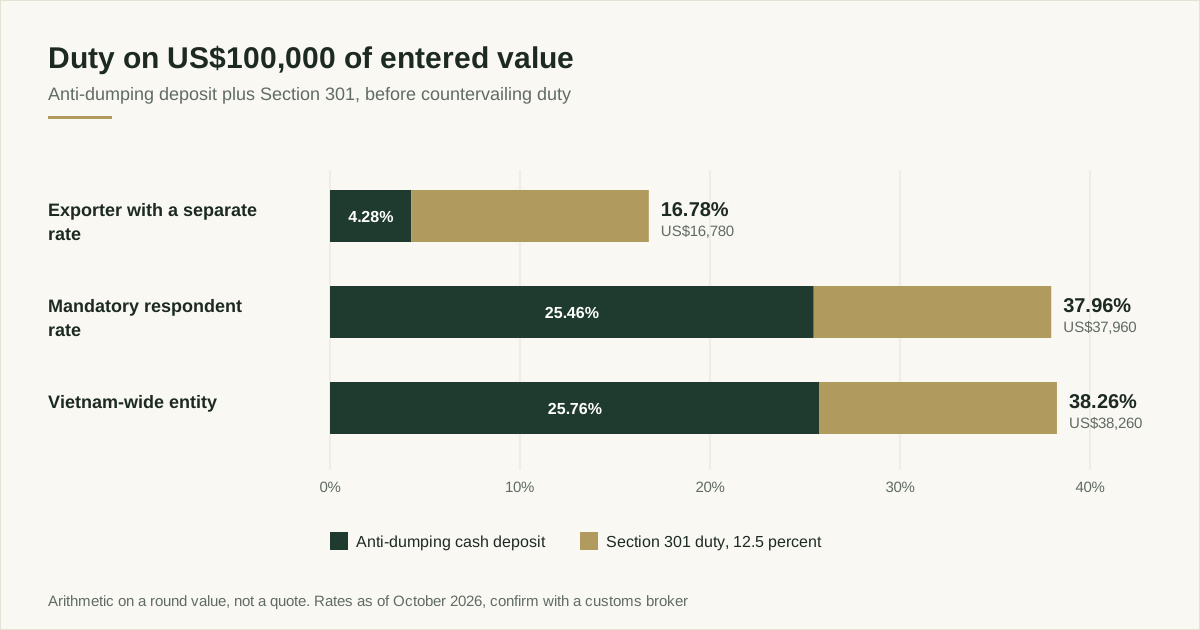
The numbers below are arithmetic on a round entered value of US$100,000, not a quote. They show the duty only and leave out the countervailing duty, freight and broker fees.
| Exporter case | Anti-dumping deposit | Section 301 at 12.5 percent | Duty total | Share of value |
|---|---|---|---|---|
| Separate rate at 4.28 percent | US$4,280 | US$12,500 | US$16,780 | 16.8 percent |
| Mandatory respondent at 25.46 percent | US$25,460 | US$12,500 | US$37,960 | 38.0 percent |
| Vietnam-wide entity at 25.76 percent | US$25,760 | US$12,500 | US$38,260 | 38.3 percent |
The gap between the first and second line is US$21,180 on one US$100,000 container. That is why the exporter name, not the country, is the first line of your costing sheet. The size grade and price drive the entered value, as explained in our guide to Vietnam shrimp size grades and pricing.
How this changes the comparison with India and Ecuador
On the Section 301 layer alone, Vietnam sits 2.5 points above India, Ecuador and Indonesia. That is not the whole picture, because each of those origins has its own anti-dumping and countervailing history, with its own review cycle. The honest comparison is the total duty by named exporter, plus freight, plus quality and lead time. Our comparison of Vietnam, India and Ecuador shrimp suppliers covers the non-duty side. Prices and terms also interact with duty: a lower FOB price lowers the base on which every ad valorem layer is charged, and the payment schedule in our guide to payment terms and the first order timeline should leave room for a duty bill that arrives with the entry.
What to write into your request and contract
- The exact legal name of the exporter, and a rule that the invoice and entry carry that name only.
- The tariff line you will enter under, agreed with your broker.
- The Incoterm: on FOB or CIF you are the importer of record and you pay every layer.
- A clause that no party will reimburse anti-dumping duties without the correct certificate.
- A rule for what happens if a final review result changes the deposit between order and entry.
- A review date for the whole costing sheet, because the 2026 rates may move again.
The duty layers feed into the landed cost in our guide to the Vietnam shrimp export price.
Next step
Take your target size grade and price, run the table above for the two or three exporters you are considering, and add the result to your landed cost. Send your spec through the request form and we match you with up to 3 Vietnam processors. They reply within 24 business hours, and you can compare their offers with the exporter name and Incoterm written on each.
See also: US shrimp import requirements, as of October 2026.
Sources
- Commerce, final results of the 2023 to 2024 anti-dumping review, 91 FR 8429 (23 February 2026)
- Commerce, preliminary results of the 2024 to 2025 review, 91 FR 27002 (13 May 2026)
- Commerce, final countervailing duty determination, 89 FR 85500 (28 October 2024)
- USTR, Section 301 forced-labor actions, 91 FR 47318 (28 July 2026)
- USTR press release on the final forced-labor actions (23 July 2026)
- US International Trade Commission, Harmonized Tariff Schedule, 0306.17 and 1605.21
- Cozen O’Connor, summary of the Supreme Court IEEPA ruling and Section 122 (February 2026)
- Aqua Culture Asia Pacific, report on Section 301 duties on seafood (25 July 2026)
Frequently asked questions
What is the US tariff on Vietnam shrimp in 2026?
As of October 2026 a US importer faces four layers: a base duty of zero, an anti-dumping cash deposit that depends on the exporter, a countervailing duty and a 12.5 percent Section 301 duty in force since 24 July 2026. Shrimp is not on the exemption lists, according to trade press. Confirm the entry with a customs broker.
Do anti-dumping duties apply to every Vietnam shrimp exporter?
The order covers all Vietnam frozen warmwater shrimp, but the rate is set per exporter. In the review published in February 2026, 22 exporters with a separate rate got a cash deposit of 4.28 percent, two mandatory respondents 25.46 percent and the Vietnam-wide entity 25.76 percent.
Do Section 301 duties stack with anti-dumping duties?
Yes. The USTR notice says products it covers stay subject to antidumping, countervailing and other duties. The 12.5 percent Section 301 duty is charged in addition to the anti-dumping and countervailing cash deposits. The importer of record pays all of them at entry unless the contract shifts the cost.
Which date decides the duty rate on a shrimp shipment?
The entry date decides it, not the ship date. The Section 301 duty applies to goods entered on or after 12:01 a.m. Eastern time on 24 July 2026. Only goods already loaded and in transit before that time and entered before 28 July 2026 were spared.
Ready to price this spec?
Send your species, size grade and certificate list. We match you with up to 3 Vietnam processors and reply within 24 business hours.
Get matched with a shrimp supplier