Guides / Specification
Cooked shrimp rings and party platters: how to spec a seasonal US retail programme from Vietnam
October 11, 2026
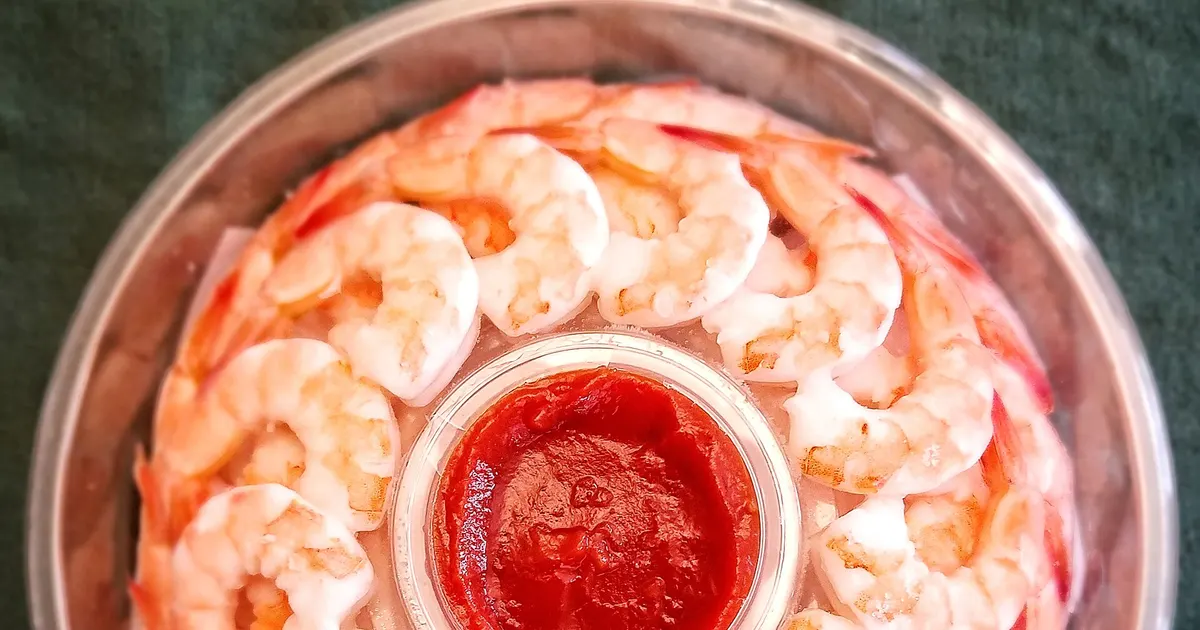
Every November a large share of US supermarkets stack frozen shrimp rings by the front door. A ring is a simple product to look at and a surprisingly demanding one to make. The shrimp must be uniform, clean, well colored and arranged by hand, and the tray must survive freezing, shipping and a consumer’s refrigerator.
This guide explains how rings and platters are built and what to put in a spec and a calendar so a Vietnam plant can deliver on time.
What goes into a ring or platter
A ring has four parts: the shrimp, the tray, the sauce and the film or lid. The shrimp are cooked, peeled, deveined and tail-on, graded tightly by size and color. The tray is a clear plastic base with a center well for a sauce cup. The cup holds cocktail sauce. A lid or film seals the pack and gives the shopper a clear view of the shrimp.
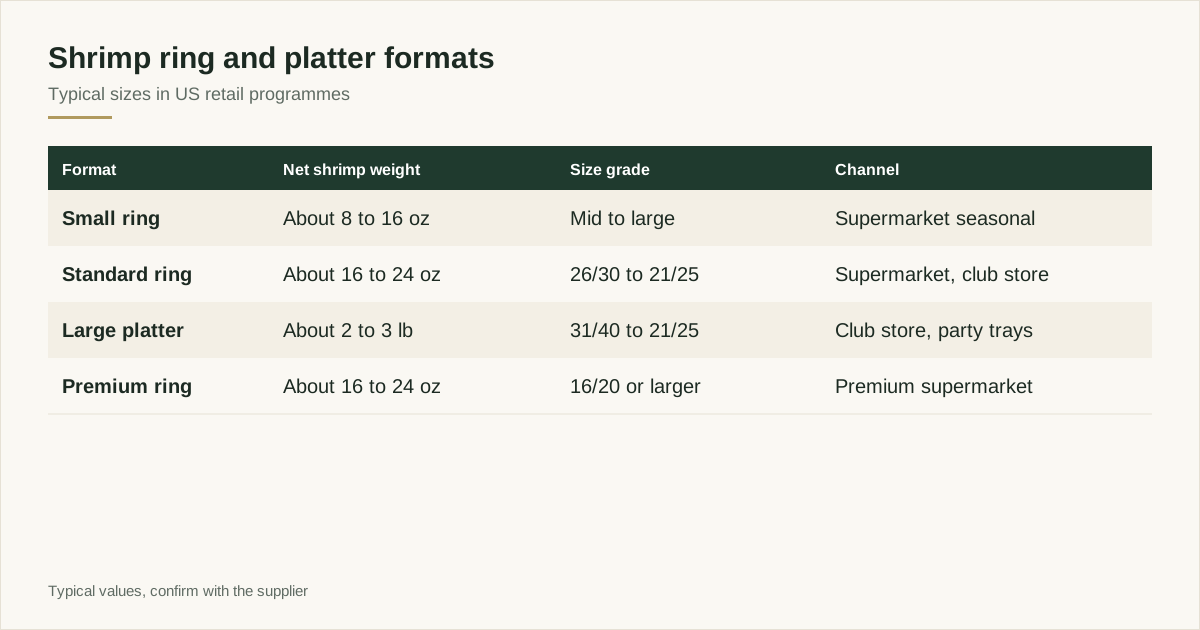
A party platter is a larger version, often with a rectangular or oval tray, more shrimp and sometimes a lemon wedge or garnish. Weights run from about 1 pound for a small ring to several pounds for a party tray. Packs vary by retailer.
| Format | Typical net shrimp weight | Typical size grade | Typical channel |
|---|---|---|---|
| Small ring | About 8 to 16 oz | Mid to large | Supermarket seasonal |
| Standard ring | About 16 to 24 oz | 26/30 to 21/25 | Supermarket, club store |
| Large platter | About 2 to 3 lb | 31/40 to 21/25 | Club store, party trays |
| Premium ring | About 16 to 24 oz | 16/20 or larger | Premium supermarket |
The figures show common patterns and vary by retailer. Always work from the retailer’s own pack spec.
Making the shrimp
The shrimp for a ring start as raw, peeled and deveined, tail-on shrimp, then cook on the line described in our guide on cooked shrimp processing and Listeria control. The key differences are grade tightness and color. A ring shows every shrimp, so the plant sorts for uniform size, curve and color. Pieces that are too curled, too pale or too small go to other products.
Raw material quality matters more than in a bag. Defects that disappear in a mixed bag stand out in a circle of twenty shrimp. Check the plant’s intake sorting and its photo chart, and see the defect guidance in our article on frozen shrimp quality defects.
Arranging by hand
Plants build rings by hand. Workers pick pieces from a sorted stream and arrange them tail-out around the sauce well in a set pattern, usually in one or two layers. The speed and consistency of this step set the labor cost and the look. A trained worker can build a ring in a short time, but the pattern needs practice, and a plant that runs rings only in the holiday season must hire and train staff.
Some plants arrange shrimp before freezing, in the tray, so the shrimp freeze in place. Others arrange after IQF freezing, using frozen pieces. Pre-arranged freezing can create contact marks and glaze bridges between shrimp, while post-IQF arrangement needs a cold room to prevent thawing. Ask each plant which method it uses and look at a sample.
The sauce and the cup
The cocktail sauce is a separate component with its own food safety and label rules. Many importers source the sauce in the US and add the cup at a co-packer or in the import warehouse, so the shrimp tray leaves Vietnam with an empty well. Others ask the plant to pack a sealed cup. A cup supplied by the plant needs its own specification, shelf life and allergen declaration.
Settle the sauce plan before you design the tray. Cup size, well shape and the way the cup is held in place affect the shape of the tray and the pack-out. Agree who owns the recipe, who sources the cup and who handles the label for the sauce.
Labels and US rules
US retail packs carry several mandatory elements. The label must show the product name, the net quantity, the ingredient list with allergen statement, the name and place of business of the importer or distributor and the country of origin. For fish and shellfish, US country of origin labeling also requires a statement of whether the product was farm-raised or wild-caught. Shrimp is a crustacean allergen and must appear in the allergen declaration.
Importers also carry responsibilities under US food safety rules. They must verify that the foreign supplier produces food that meets US safety requirements, and seafood has its own HACCP regulation that places duties on processors and importers. Retailers add their own audits and often require a recognised food safety scheme. Certificates belong to the plant and the certification body, and a buyer should verify them with the issuer. Our guide on certifications by export market explains what each market expects.
Check the current requirements with your importer or a US food regulatory adviser before you finalize a label.
Planning a seasonal calendar
The calendar is the hard part of a ring programme. Demand peaks around a few dates, and the supply chain needs months.
| Step | Typical timing before the holiday | Notes |
|---|---|---|
| Retailer programme set | Many months ahead | Item, size, pack and price agreed |
| Plant selection and trial | Mid-year | Sample trays, audit, label proofs |
| Raw material booking | Before the peak raw material period | Plant secures size and color |
| Production | Late summer to autumn | Cooking, arranging, freezing, packing |
| Shipping | Autumn | Allow for port delays and inland transit |
| Retail set | Weeks before the holiday | Freezer space and display |
Treat the timings as a pattern, not a promise. Ask the plant for its own calendar, and add a buffer for port delays and for late label approval. A missed week in autumn can cost the whole season, since stores cannot sell a ring after the holiday at the same price.
Ready to price this spec? Get matched with a shrimp supplier
Cost drivers and price
Four factors drive the cost of a ring. Raw material is the largest, and it follows the size grade and the season. Labor for sorting and arranging is the second. Packaging, including the tray, lid and cup, is the third. Freight and cold storage are the fourth, since trays take more space than bags and need careful handling.
A ring costs more per kilogram of shrimp than a bag of the same size shrimp, and the premium reflects labor and packaging. When you compare quotes, ask for a price per tray and a price per kilogram of net shrimp, with the packaging breakdown. Check glaze and net weight on a sample tray, as the guide on glaze, net weight and yield describes.
Pack-out, pallets and freight
Trays are bulky. A carton holds a small number of rings, and a pallet holds fewer cartons than a pallet of bagged shrimp. Freight cost per kilogram of shrimp is therefore higher, and a reefer container fills up by volume before it fills up by weight. Work out the cartons per container early, since it affects the price per tray.
Carton design matters for protection. A tray that cracks in transit is lost, so cartons need dividers or tight packing, and pallets need corner boards and wrap. Ask the plant for a pack-out drawing with the carton dimensions, the number of trays per carton, the cartons per pallet layer and the pallets per container. Test one full pallet in transit before the main run if the programme is new.
Also plan the cold store at destination. Seasonal products arrive in a short window, and warehouses fill up around the same time. Book space early, and agree on delivery slots with the store’s distribution centre.
Sampling and approval before the run
Retail buyers approve a pre-production sample before the full run. The sample shows the shrimp, the arrangement, the tray, the film and the label. A buyer should check the net weight of shrimp, the count of pieces, the color against the chart, the strength of the seal and the readability of the barcode.
Run a thaw and serve test on a sample ring. Thaw it in a refrigerator for the time stated on the pack, open it and look at the shrimp and the sauce well. Check for water in the tray, for shrimp stuck together and for color change. A tray that looks poor after thawing at home will draw complaints, even if it looked perfect when it left the plant.
Record approval in writing, with photos of the approved sample, and keep a retained sample from the approved run. If a later lot differs, the photos and the retained sample settle the question.
Cold chain and shelf life
Rings must stay frozen at minus 18 degrees Celsius or colder from plant to store. Temperature swings damage both shrimp and packaging, and a cracked tray is a rejected tray. Mark production dates and best-before dates on cartons and trays, and set a maximum age at arrival so the retailer has enough shelf life.
Consumers thaw rings in the refrigerator, so the label should carry clear thaw and serve instructions. Retailers often ask for a tamper-evident film and a barcode that scans through the film.
What to write in the request
- Format: ring or platter, tray and well design, lid or film.
- Shrimp: species, size grade, tail-on, peeled and deveined, cooked, color chart.
- Net shrimp weight per tray and tolerance.
- Arrangement pattern and method: before or after freezing.
- Sauce plan: who supplies the cup and the recipe, and the label for the sauce.
- Labels: net quantity, ingredients, allergens, origin and farm-raised declaration, barcode.
- Calendar: production window, shipping date and arrival date.
- Cold chain and documents: temperature, maximum age, specification, Listeria controls.
Next step
Work backward from the date the product must be on shelf, and send that date with the request. Send your spec through the request form and we match you with up to 3 Vietnam processors that make cooked platter products. They reply within 24 business hours, and you can compare their calendars and sample trays early in the year.
See also: the PDTO shrimp specification: peeled, deveined, tail on.
Frequently asked questions
What is a shrimp ring?
A shrimp ring is a tray of cooked, peeled, tail-on shrimp arranged in a circle around a cup of cocktail sauce, sold frozen for parties and holidays. Sizes run from about one pound to several pounds for platters. Retailers sell most of them in the weeks around major holidays.
When should I place an order for holiday shrimp rings?
Plan months ahead. Plants need time for raw material, production and shipping, and retailers set programmes well before the holiday. A buyer who targets late-year demand should start talking to plants in the middle of the year and confirm the order before the peak raw material period.
Does the sauce come from Vietnam?
Usually not. Many importers add the cocktail sauce cup in the destination country, where it can follow local label and shelf life rules. Some plants can supply it. Decide early who sources the sauce, since it affects the tray design and the label.
Ready to price this spec?
Send your species, size grade and certificate list. We match you with up to 3 Vietnam processors and reply within 24 business hours.
Get matched with a shrimp supplier