Guides / For Processors
Shrimp anti-dumping review: the records a Vietnam exporter needs when Commerce sends a questionnaire
November 14, 2026

A US anti-dumping duty on Vietnam shrimp is not set once and left alone. Each year the US Department of Commerce can review the shipments of a past 12 months, and the exporter’s rate, plus what the importer finally pays, depends on what the exporter files and what records it can produce when Commerce asks. This guide covers the review calendar, the separate rate filing and the sales and production records that the questionnaire asks for. It does not explain what the rates are or how to price around them, which our guide to winning a first US importer order and the 2026 tariff guide cover. It is also not legal advice. A trade lawyer or your industry association should confirm your own position.
How a review runs, with the latest dates
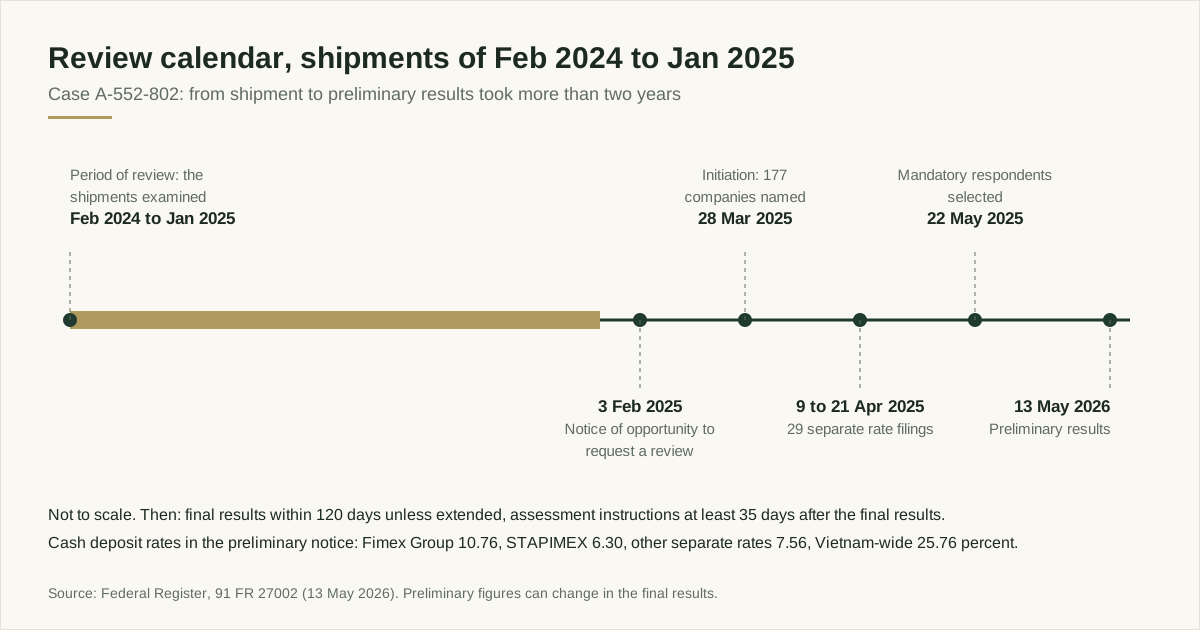
The order on frozen warmwater shrimp from Vietnam (case A-552-802) was published in the Federal Register on 1 February 2005. Reviews follow a fixed rhythm. The dates below are for the review of shipments from 1 February 2024 to 31 January 2025.
| Step | Date | What happened |
|---|---|---|
| Opportunity to request a review | 3 February 2025 | Notice published |
| Initiation | 28 March 2025 | Review opened for 177 companies, including name variants |
| Separate rate filings | 9 to 21 April 2025 | 29 companies filed timely applications or certifications |
| Respondent selection | 22 May 2025 | Fimex Group and STAPIMEX chosen as mandatory respondents |
| Preliminary results | 13 May 2026 | Published after deadlines were tolled by 47 and then 21 days because of the federal shutdown |
| Final results | Within 120 days of the preliminary notice, unless extended | Check the Federal Register for the current status |
| Assessment instructions | Not earlier than 35 days after the final results | If a summons is filed at the Court of International Trade, entries stay unliquidated until the time to request an injunction, 90 days after publication, has passed |
Two lessons follow. First, a shipment made in February 2024 was still being examined more than two years later, so records must outlive the shipment by a long margin. Second, the next review has already started. Commerce opened the review of shipments from 1 February 2025 to 31 January 2026 on 31 March 2026 (91 FR 15951), and the same cycle of separate rate filings and respondent selection applies.
What the separate rate filing decides
In non-market economy cases Commerce starts from a rebuttable presumption that all companies in the country are under government control and should get a single rate. An exporter gets its own rate only by showing that it is free of both de jure and de facto government control over its export activities. The initiation notice lays out the routine:
- A company that held a separate rate in the most recent segment it took part in files a certification that it still meets the criteria.
- A company without a separate rate, or one that changed its corporate structure, acquired new companies or facilities or changed its official company name, files a full application.
- Both are due 14 calendar days after the initiation notice, and the rule applies equally to state-owned firms, wholly foreign-owned firms and sellers that buy and export the goods.
- Commerce may select respondents from customs data or from a quantity and value questionnaire. Where a company that filed for a separate rate is picked as a mandatory respondent, it loses the separate rate unless it answers every part of the questionnaire.
- A company named in the initiation notice that had no exports, sales or entries in the period can notify Commerce within 30 days. Where there are no suspended entries, Commerce intends to rescind the review for that company. In the 2024-2025 review it rescinded the review for eight separate-rate companies on that ground.
The stakes are visible in the preliminary results of 13 May 2026. Fimex Group got 10.76 percent and STAPIMEX 6.30 percent, the 27 separate-rate companies not examined got 7.56 percent, and the Vietnam-wide entity stood at 25.76 percent. These are preliminary and can change in the final results, so confirm the current figures before you rely on them.
Section A: the company file
Every exporter and producer is asked to complete Section A of the questionnaire. Commerce publishes questionnaire templates for non-market economy reviews on trade.gov, and the review template posted in August 2026 is the one used here. The case-specific questionnaire is what you receive. Section A covers organization, accounting and markets. Among other things it asks:
- who manages the company and how those people were selected, and whether any authority must be notified;
- whether any manager must meet foreign exchange targets set by an authority;
- who holds and controls the account where export earnings are deposited, and how export profits are used;
- the chart of accounts and the audited financial statements for the two most recent fiscal years plus later monthly or quarterly statements;
- internal profit and loss reports for the product line, and financial statements of affiliates involved in production or sale.
Keep a current version of each of these as a standing file. They are also the supporting documents behind a separate rate certification.
Section C: every US sale, from the invoice to the bank
Exporters answer Section C. The template asks for a record for each sale to the United States, with fields such as the invoice date, the date of sale if different, invoice number, shipment date, date of receipt of payment, terms of delivery and payment, gross unit price, discounts and rebates. It also lists the movement costs: foreign inland freight to the warehouse and the port, brokerage and handling, international freight, marine insurance and the US port of entry, plus commissions, credit expenses, the entered value and the importer.
Commerce asks for the date of sale under its own criteria, which may differ from the date you use in the ordinary course of business. The questionnaire tells the company to ask the official in charge if unsure. In practice each shipment needs one folder where these records meet:
| Record | Where it normally comes from |
|---|---|
| Contract or purchase order and amendments | Sales file |
| Commercial invoice and packing list | Export documents |
| Bill of lading | Forwarder or carrier |
| Payment evidence | Bank advice, matched to the invoice |
| Inland haulage, port and brokerage charges | Trucker, terminal and broker invoices |
| Freight and insurance (CFR or CIF sales) | Forwarder invoice, insurance certificate |
| Discounts, rebates, claims and credit notes | Customer correspondence and accounting |
If a claim or credit note changes the price, keep the paperwork next to the invoice. A price that moved after the sale is the kind of fact that surfaces in a questionnaire several months later.
Ready to price this spec? Get matched with a shrimp supplier
Section D: the producer’s consumption records
Only the producer answers Section D, on factors of production. Commerce normally values those inputs using prices from a surrogate market-economy country, so what it needs from the plant is the quantities. The section asks for the actual quantities consumed to make one unit of shrimp. For the most significant raw material, for electricity and for labor, it asks the company to reconcile the figures to its cost-of-production ledger or equivalent. Other points from the questionnaire:
- The report covers total production of the product, not only the part sold to the United States, and each plant that makes it is reported.
- Normally factors are based on actual inputs during the period of review, recorded under the normal accounting system.
- The company lists every document generated or relied on at each stage, for example purchase invoices, warehouse sub-ledgers, consumption worksheets, bills of material, yield loss reports and finished goods sub-ledgers, and states how long it normally keeps the paper copies.
- Any input bought from a market-economy supplier in market-economy currency is reported with its price and supporting invoices.
For a shrimp plant this matches records it already has for food safety. Raw shrimp intake by lot, yield by lot and finished lot dispatch are the same series an importer reads in a plant audit, and they feed the yield figures the plant uses to price. Keep them in one system with consistent lot codes.
Habits that make a response possible
- One folder per shipment. Contract, invoice, bill of lading, payment, charges and credit notes together, indexed by invoice number.
- Reconcile monthly. Sales by invoice should tie to the books, and raw shrimp consumption should tie to the cost ledger. The questionnaire requires reconciliations, which are hard to create two years later.
- Keep originals. Commerce asks for direct unaltered copies of the documents and says altered or illegible ones cannot count as evidence without the required certification and explanation.
- Match names exactly. Keep your legal name, its variants and any change of structure on file. A change is a reason to file a full application and not a certification.
- Report no sales on time. A notice within 30 days of initiation, where it applies, keeps the file simple.
- Report entries under the right case number. For entries that came in under a respondent’s case number but were not in its reported sales, Commerce said it will liquidate them at the Vietnam-wide rate.
- Agree a retention period. The Commerce documents read for this guide set no retention period for a foreign exporter. Ask US trade counsel for yours. Do not discard a shipment’s file until its review and any court action have closed.
The importer side
The US importer carries its own duties, including a certificate on reimbursement of anti-dumping duties before liquidation (19 CFR 351.402(f)(2)). Share what you can without disclosing business proprietary data, and expect importers to ask whether you filed for a separate rate and when. If you want requests that match your grades and terms, register as a processor. We pass buyer requests to registered plants whose spec fits, and the plant and the buyer settle terms between themselves.
The importer’s side of these rates is in our guide to the Vietnam shrimp export price.
See also: US shrimp import requirements, as of October 2026.
Sources
- Federal Register, Certain Frozen Warmwater Shrimp From Vietnam: Preliminary Results and Rescission, in Part, of Antidumping Duty Administrative Review; 2024-2025 (91 FR 27002, 13 May 2026)
- Federal Register, Initiation of Antidumping and Countervailing Duty Administrative Reviews (91 FR 15951, 31 March 2026)
- US International Trade Administration, AD NME administrative review questionnaire template (August 2026)
- eCFR, 19 CFR 351.408, calculation of normal value for nonmarket economy countries
Frequently asked questions
What happens if a Vietnam shrimp exporter does not file for a separate rate?
Commerce treats Vietnam as a non-market economy and presumes all exporters are under government control, so one rate applies unless an exporter shows it is independent. Companies that do not establish a separate rate stay in the Vietnam-wide entity, whose cash deposit rate in the May 2026 preliminary notice was 25.76 percent. Check the current notice, since rates change each review.
Does every exporter have to answer the full questionnaire?
No. When many companies are under review, Commerce can limit individual examination to a few mandatory respondents, two in the 2024-2025 review (Fimex Group and STAPIMEX), chosen from customs data or a quantity and value questionnaire. Other separate-rate companies get a rate averaged from those two. A company that files for a separate rate and is then selected must answer every part.
Which records does Commerce ask a shrimp producer to report?
Exporters report each US sale in Section C: dates, prices, terms, discounts, freight, brokerage and the importer. Producers report factors of production in Section D: raw shrimp, labor, electricity, packing and by-products per unit, reconciled to the cost ledgers. All companies answer Section A on ownership, management and accounting.
How long should a shrimp exporter keep review records?
The Commerce documents reviewed here set no retention period for foreign exporters, and the questionnaire asks how long you keep each production record. A review of shipments from February 2024 only reached preliminary results in May 2026, more than two years later. Ask US trade counsel for your period, and do not discard a shipment's file until its review and any court appeal have closed.
Ready to price this spec?
Send your species, size grade and certificate list. We match you with up to 3 Vietnam processors and reply within 24 business hours.
Get matched with a shrimp supplier