Guides / Choosing a Supplier
Shrimp for foodservice chains: how portion counts, pack sizes and tolerances fit together
October 22, 2026
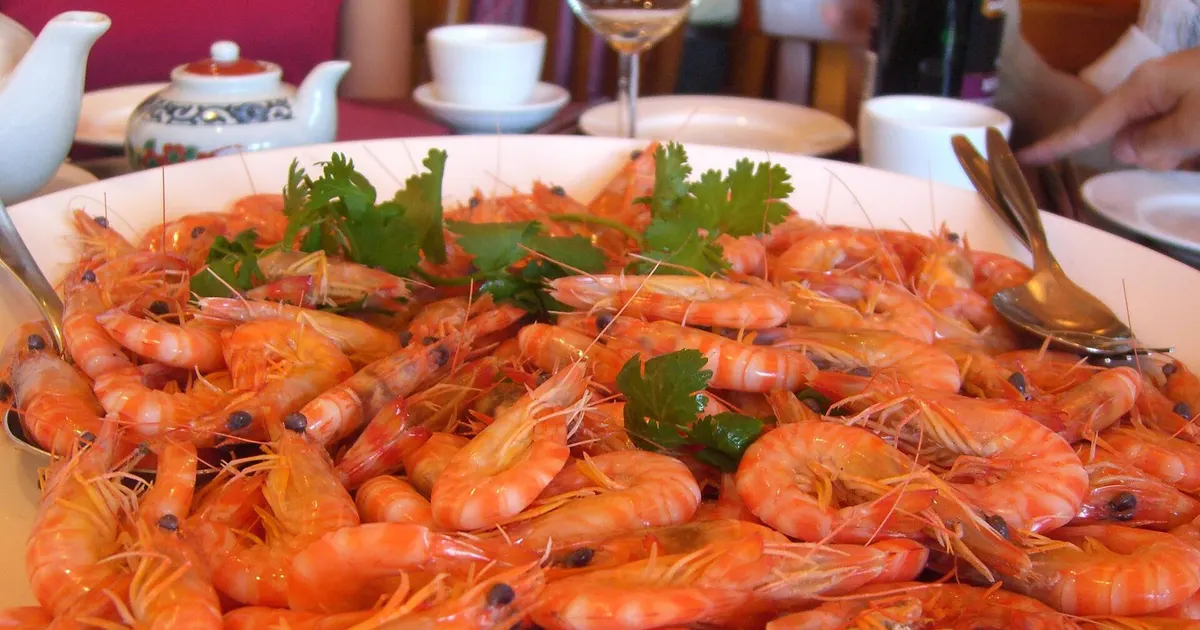
A restaurant chain does not buy shrimp by the kilogram. It buys plates. The menu says six shrimp on this dish and eight on that one, and every kitchen across hundreds of locations must serve the same plate at the same cost. Sourcing for foodservice means turning that promise into a size grade, a pack and a price per portion.
This guide shows how to make that conversion and what to write in a spec for a Vietnam plant.
Start with the plate, not the grade
A chain’s product team usually defines three things for each dish: the number of shrimp on the plate, the target portion weight and the cooking method. The size grade follows from the first two. If a dish needs six shrimp and a portion weight of about 100 to 120 grams, the grade must give pieces of 17 to 20 grams each.
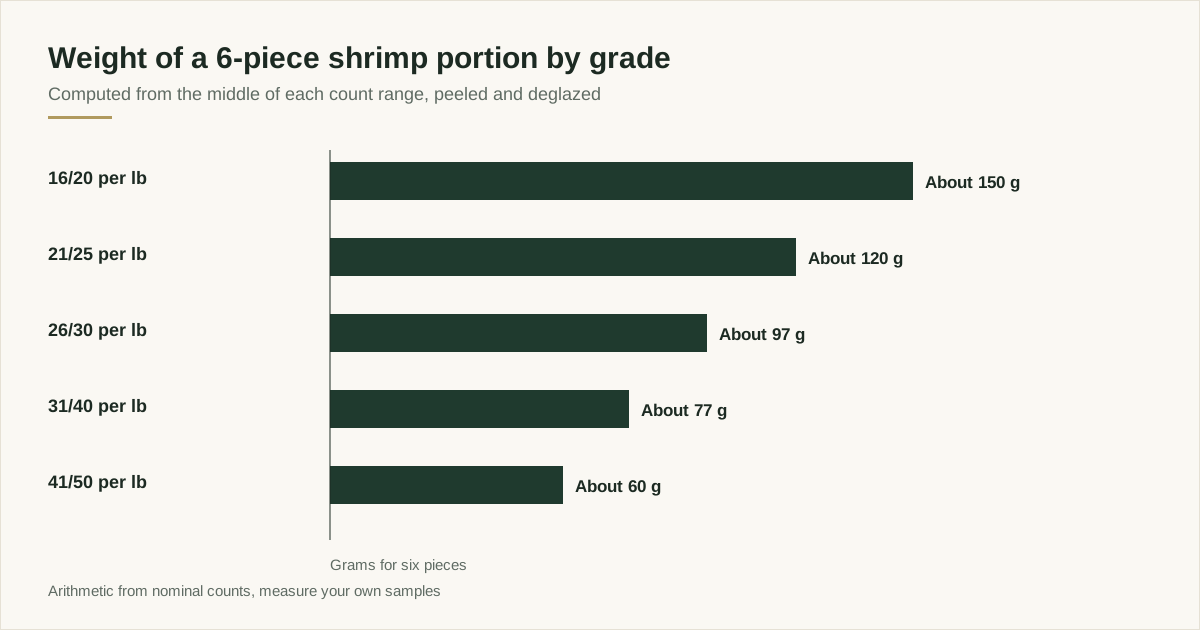
The table shows how portion weight changes with the grade for six pieces. It uses the middle of each count range, per pound of peeled and deglazed shrimp, and ignores cook loss. Treat it as a quick planning tool.
| Grade (per lb) | Approx. grams per piece | Weight of 6 pieces | Weight of 8 pieces |
|---|---|---|---|
| 16/20 | About 25 | About 150 g | About 200 g |
| 21/25 | About 20 | About 120 g | About 160 g |
| 26/30 | About 16 | About 97 g | About 130 g |
| 31/40 | About 13 | About 77 g | About 102 g |
| 41/50 | About 10 | About 60 g | About 80 g |
The figures are arithmetic from nominal counts. Real lots vary, so measure the average piece weight of your own samples.
Chains often work in the opposite direction too. A cost target per portion sets a maximum weight, and the weight sets the grade and the piece count the menu can promise. Both directions lead to the same specification: a grade, a tight range and a tolerance on the average.
Tight counts and tolerance
A size grade such as 21/25 allows a spread of pieces per pound, and a bag may contain shrimp from both ends of the range. For a chain, that spread produces visible differences between plates. Foodservice specs therefore add two controls.
- Count range: a narrower range than the standard grade, or a statement of the average count and the maximum deviation.
- Weight check: a rule such as a sample of one hundred pieces from several bags must fall within a stated count per pound on average.
State how the count is measured. Count the deglazed, drained shrimp from a sample of several cartons, and use the same method for every lot. Our guide on size grades and pricing explains how counts are written and why the method matters.
Raw form and treatment for kitchens
Foodservice menus use shrimp in many ways, and the form follows the use.
| Use | Common form | Notes |
|---|---|---|
| Fried shrimp, tempura | Peeled and deveined, tail-on, raw | Often butterflied or nobashi style |
| Scampi, sauté, pasta | Peeled and deveined, tail-on or tail-off | Mid sizes, consistent count |
| Grill and skewers | Shell-on or peeled, tail-on | Larger sizes |
| Salads, cocktail | Cooked, peeled, tail-on | Cooked line, tight color |
| Soups, rice dishes | Small peeled, tail-off | Cheaper grades |
The treatment matters too. Chains with a clean-label policy ask for no phosphate or limited additives, and others accept soaked shrimp for yield. Cooked shrimp need a cooked line, and the guide on cooked shrimp processing explains the controls. For the raw forms, see shrimp processing forms.
Pack sizes and why they matter
Kitchens open a bag, use part of it and reseal. The pack size must fit the speed of use so that shrimp do not sit open in the freezer and lose quality. Common foodservice packs include the following.
| Pack | Typical bag | Typical master carton | Typical fit |
|---|---|---|---|
| Small bag | 1 kg or 2 lb | About 10 kg or 20 lb | Busy restaurants with several shrimp dishes |
| Medium bag | 2 kg or 5 lb | About 10 kg or 20 to 30 lb | High-volume kitchens |
| Block or large bag | 2 kg block, 5 kg bag | About 10 to 20 kg | Central kitchens and further processing |
Ask the chain’s distributors what they handle. Distributor systems have case dimensions, pallet patterns and barcode rules, and a carton that does not fit them can cause rejections at the warehouse.
The carton label should show the product name, the grade, the net weight, the production date, the lot code and the best-before date, along with the barcode scheme the distributor uses. Many chains require a GS1 barcode and specific case marking. Ask for the labeling guide at the start, not after the first run.
Price per portion, not per kilogram
A kilogram price hides the effect of grade, glaze and yield. Convert every offer to price per portion with a simple formula:
price per portion = price per kilogram of net deglazed shrimp × portion weight in kilograms ÷ kitchen yield
Use an illustration: if net deglazed shrimp costs 10.00 per kilogram and a portion uses 0.12 kilograms of raw shrimp, the shrimp cost per portion is 1.20 before cooking loss. This is arithmetic for illustration only, and it shows why a one percent change in glaze or yield matters when you serve thousands of plates.
Run the same calculation on every quote, with glaze and net weight confirmed as in our guide on glaze, net weight and yield. If one plant quotes a lower kilogram price at a higher glaze, the cost per portion can be higher.
Consistency across hundreds of locations
A chain needs the same product in every lot, every month, for years. That is a different test from a one-off order. Look for evidence of consistency.
- A written specification with photos for color, defects and shape.
- A sampling and inspection plan that the plant runs on every lot.
- Records for glaze, count and defects on the last several lots.
- A named quality contact who answers claims within a stated time.
- A calendar of raw material supply by size, so the plant can keep supply even when the harvest changes.
Consistency also depends on two or more qualified sources. Many chains approve at least two plants for each item, so a supply problem at one plant does not stop the menu. When you request quotes, ask each plant whether it can supply from a second approved facility under the same specification, and what the lead time is.
Ready to price this spec? Get matched with a shrimp supplier
Menu engineering and what the grade does to the plate
Chains test a new shrimp item in a few restaurants before they roll it out. The test shows how the shrimp look on the plate, how they cook under a real rush and how guests react. A grade that looks right in a test kitchen can look thin on a plate with a heavy sauce, and a grade that looks generous on a flat plate can look lost in a bowl of pasta.
Plan the test around three questions. Does the plate look full with the planned piece count? Does the shrimp hold its shape and color after the cook method the kitchens use? Does the cost per portion fit the menu price at the target margin? If the answer to the first is no, the chain can raise the count or the grade. If the answer to the third is no, it can lower the grade, shift to a different form or reduce the count, and the plant can quote each option so the chain decides with real numbers.
Also test the shrimp in the slowest kitchen. A bag of shrimp that sits half open for a week in a quiet restaurant picks up frost and loses quality faster than one that a busy kitchen uses in a day. A smaller bag may solve the problem at a small cost.
Seasonality and promotions
Chains run shrimp promotions several times a year, such as an all-you-can-eat week or a seasonal dish. A promotion can double the weekly volume of one item, and the plant needs notice to find raw material and book production. Share the promotion calendar early and agree on a forecast with a band, for example a base volume and an upside volume with a lead time for the upside.
Raw material supply also moves with the season. Some sizes are tighter at certain times of the year, and prices follow. A chain that fixes its grade and its price for a whole year gains stability but may pay for a premium in the tight months. Many chains split the volume into a fixed base at a set price and a variable part that follows the market, and the contract states how the index is set.
Audits and documents
Chains audit their suppliers, and plants usually need to show a recognised food safety scheme, a social compliance audit and the regulatory approvals for the market. Certificates belong to the plant and the certification body, and a buyer should verify them with the issuer. Our guide on shrimp certifications by export market explains which schemes each market expects.
Typical documents for each shipment include the specification sheet, the lot test results for residues and microbiology, the certificate of origin and the health certificate. Agree the document list and the delivery time of each document before the first order.
Handling instructions that protect the plate
A spec does not end at the plant door. Chains train kitchens on how to store and thaw shrimp, and the instructions affect the plate as much as the grade. Common advice includes thawing in a refrigerator or under cold running water in the bag, using thawed shrimp within a stated time and never refreezing. Ask the plant to print the instructions on the carton and the bag and to match the wording to the chain’s training material.
Also share the kitchen’s real conditions with the plant: freezer temperature, how long a bag stays open and the cooking method. A plant that knows these conditions can adjust glaze, treatment and pack size, and it can warn you if a spec asks for something that will not survive the kitchen.
What to write in the request
- Menu use for each item: dish, piece count per plate and portion weight.
- Grade and tight range, or average count with the maximum deviation, and the count method.
- Form and treatment: peeled, shell-on, cooked, tail rule and additive policy.
- Net weight basis, glaze limit and price per kilogram of deglazed product.
- Pack: bag size, bags per carton and carton weight, with case labeling and barcode rules.
- Calendar: annual volume, monthly volume and delivery points.
- Audit and documents: scheme, specification, lot test results.
Next step
Take one menu item and work out the grade, tolerance and pack from the plate. Send your spec through the request form and we match you with up to 3 Vietnam processors that supply chains. They reply within 24 business hours, and you can compare their offers by price per portion.
See also: the shrimp count chart: per pound, per kilogram and grams per piece.
Frequently asked questions
How many shrimp go into a restaurant portion?
It depends on the dish and the size. Appetizers often use four to six shrimp, entrees use six to ten, and salads or pasta may use fewer, smaller shrimp. A chain fixes the piece count per portion on the menu, then chooses the size grade that gives the target portion weight.
Why do chains care about a tight count range?
Because the kitchen builds a plate by piece count, and the cost and the look depend on the weight of each piece. A wide count range means some plates look generous and others look thin. Chains therefore set a tight range and a tolerance on the average count.
What pack sizes do foodservice buyers use?
Common choices are bags of about one to two kilograms or two to five pounds in a master carton of roughly ten kilograms or twenty to thirty pounds. The best size depends on the kitchen's freezer space and how quickly it uses a bag after opening.
Ready to price this spec?
Send your species, size grade and certificate list. We match you with up to 3 Vietnam processors and reply within 24 business hours.
Get matched with a shrimp supplier