Guides / Choosing a Supplier
How to document a shrimp quality claim: short weight, defects and the notice deadline
November 7, 2026
A shrimp quality claim is decided in the first days after the container opens, not in the negotiation that follows. The buyer who wins a claim has sent the seller a written notice that names the defect, backed by a sealed sample, a weight taken by a stated method and photographs with the carton code in view. The buyer who loses usually found the problem but waited, weighed without a method or reported it as “poor quality”. This guide shows what to document for short weight, defects and temperature problems, which deadlines run against you and what to write into the order so the claim has a path before it is needed.
First decide what kind of claim it is
The kind of problem decides who you tell, what you measure and how fast.
| Problem | Usual first party | What to measure or capture | Method guide |
|---|---|---|---|
| Short weight, or glaze above the contract | Seller | Packing list, carton weights, deglazed net weight of a sealed sample | Glaze, net weight and yield |
| Wrong count or size grade | Seller | Count on deglazed weight, in the sample unit | Size grades |
| Dehydration, soft shell, breakage, black spot | Seller | Defect count in a sample, photos with a ruler | Quality defects |
| Thawed or warm lot, damaged cartons | Carrier first, then seller | Temperature display, data logger, seal number, photos of the doors opening | Reefer loading |
| Wrong label, missing document | Seller | The carton, the label text, the document set | Pre-shipment inspection |
The first party is a starting point, because the contract and the bill of lading decide who answers in the end. Two things are true for every row. First, you need a sample you can prove is from the lot. Second, the method must be the one in the contract, so write it into the order and use it on arrival. Our guide to the pre-shipment inspection describes a method that works at both ends, which means the same test at the plant and in your cold store.
Three clocks that start at arrival
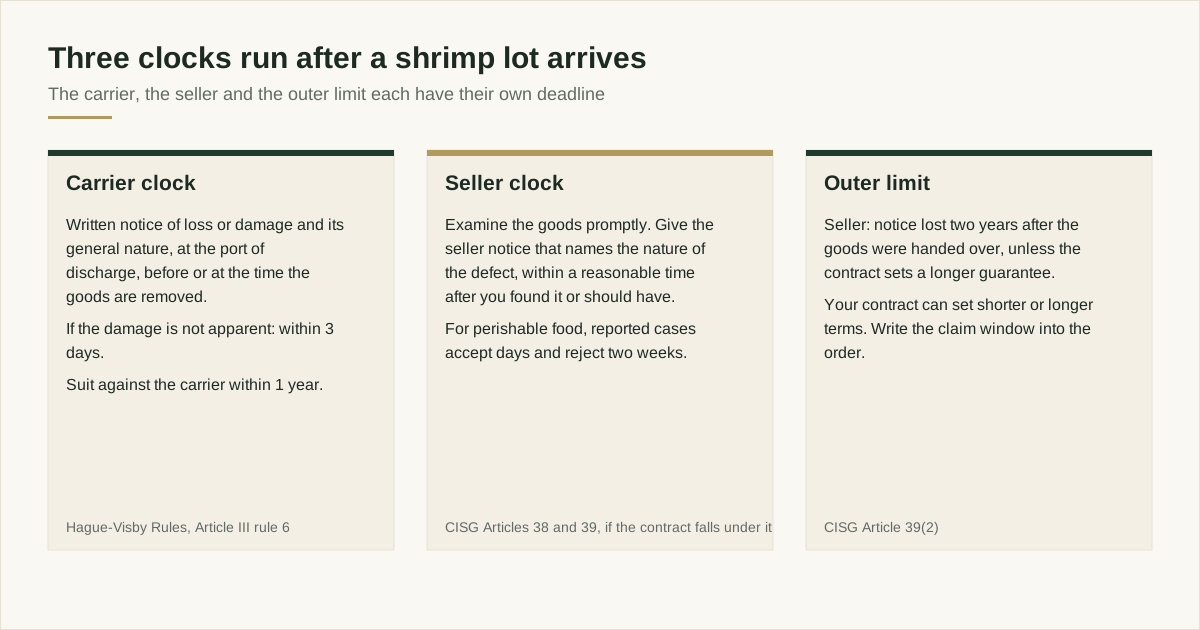
Three deadlines can run at once. None of them waits for you to finish your own checks.
The carrier clock. The Hague-Visby Rules, as reproduced in Canada’s Marine Liability Act, say the receiver must give the carrier or its agent written notice of the loss or damage and its general nature at the port of discharge, before or at the time the goods are removed. If the damage is not apparent, notice can follow within three days. Without notice, removal of the goods is prima facie evidence that the carrier delivered them as the bill of lading describes. The same rule bars suits against the carrier after one year from delivery. Which regime applies depends on your bill of lading, so ask your forwarder the day the container is booked.
The seller clock. Where the UN sales convention (CISG) governs the contract, the buyer must examine the goods promptly and loses the right to rely on a defect unless it gives the seller notice that specifies the nature of the defect within a reasonable time after it found the defect or should have found it. The convention is in force for Vietnam from 1 January 2017, and it also applies in the United States, Japan, South Korea, Germany, France, the Netherlands and Australia, according to the UNCITRAL status table. The United Kingdom is not listed. Contracts can exclude the convention, so check yours.
The outer limit. Under the same convention the buyer loses the right to rely on a lack of conformity if the seller has no notice within two years of the goods being handed over, unless a contractual guarantee period says otherwise. For frozen shrimp this limit is a long way off. The practical limit is the one you write into the contract or the one a court sees as reasonable for perishable food.
What does reasonable mean for food? The UNCITRAL digest on Article 39 lists cases. Notice within 24 hours of delivery of perishable goods and within several days for perishable tomatoes was timely. Fifteen days for fresh mushrooms and two weeks for foodstuffs were late. Frozen shrimp keeps longer than fresh produce, but a seller will point to those cases if you wait two weeks. Treat the first days as your window and send a first notice even if the analysis is not finished. This article is general information, not legal advice. For a large claim, ask a trade lawyer.
What goes into the evidence pack
Build the pack in this order, in the first two days.
- Freeze the scene. Photograph the container doors as they open, the seal number, the temperature display and the data logger screen if one is fitted. Photograph the cartons in the stack, then each carton you pull.
- Record the identity. For each carton sampled, photograph the label with lot code, size, pack date and plant code. Write the same data in a sheet.
- Weigh by the contract method. Weigh the carton gross, then deglaze and drain by the method in the contract. Codex STAN 92 sets one such method, and our pre-shipment inspection guide walks through it. Record the scale ID, the water temperature and the drain time. Photograph the scale display with the sample on it.
- Count and grade. Count the shrimp in the sample unit and divide by the deglazed weight. Photograph a counted tray with the number written on a card in the frame.
- Capture defects. Lay out the defective shrimp on a tray with a ruler. Count them against the total in the sample and write the percentage. One photo per defect type.
- Seal retention samples. Take at least two sealed samples from the same lot, one for you and one for a lab or the seller. Freeze them, label them and record where they are kept. If you need a lab test, such as sulfite or phosphate, our guide to frozen shrimp samples shows how to draw the sample.
- Keep the document set. Bill of lading, packing list, commercial invoice, health certificate, certificate of origin and the plant’s lot report.
Use an independent inspector when the claim is large. An outside report is harder to dismiss than your own photos, and the inspector can seal samples that both sides trust.
Ready to price this spec? Get matched with a shrimp supplier
The notice letter
The CISG digest is plain on what a notice must contain. It must specify the nature of the lack of conformity. A bare complaint such as “poor quality” has been held insufficient. Each defect needs its own description, and describing the symptoms is enough, so you need not explain the cause. The convention sets no form, though buyers who gave notice by telephone often could not prove it. Send it in writing by email, name the lot and carton codes, attach the evidence and state what you ask for.
A short notice has five parts:
- The lot: contract number, invoice number, container, carton codes.
- The finding: the measured figure, the contract figure, the method and the date.
- The evidence: files attached, with sample IDs and where the retention samples are kept.
- The request: replacement, credit, price adjustment per kilo short or inspection together.
- The deadline: a date for the seller’s reply that gives them a fair few days, not weeks.
Write the claim into the order before you need it
Most disputes drag on because the order says nothing about claims. Six lines remove the argument.
- Claim window: number of days from discharge to give written notice, with a longer window for hidden defects such as residue results.
- Method: the weight, count and defect method, and the sampling plan, named in the order.
- Inspector: the company that inspects before loading, and who pays for it.
- Retention samples: the plant keeps a sealed sample of each lot and confirms the storage period.
- Remedy ladder: replacement, credit or price adjustment per kilo short, with a rule for each size of shortfall.
- Costs: who pays for return, destruction, storage and re-inspection if the claim stands.
Tie these to the payment structure. Our guide to payment terms and the first order timeline explains why a balance paid against a bill of lading copy gives you less leverage than a retention held back until the arrival inspection clears. A claim is a poor substitute for a check done before loading.
When it is a regulator, not a claim
Some problems are not about the contract. If a sample shows a banned drug residue or a pathogen, the authority at the border can detain the lot, and the lot is then a compliance case first and a commercial claim second. Our guides to FDA import alerts on shrimp and RASFF notifications for shrimp show what the authorities do and what evidence you can bring.
Next step
Put the six lines above into your next request and send them through the request form. We match you with up to 3 Vietnam processors, and they reply within 24 business hours. How a plant answers on retention samples and the claim window tells you early how it behaves when a claim arrives.
See also: shrimp glaze levels, net weight and the Codex deglazing method.
Sources
- UNCITRAL, status of the United Nations Convention on Contracts for the International Sale of Goods (Viet Nam, United States, Japan, Korea, Germany, France, Netherlands, Australia)
- CISG Article 39, text (Lexmea reproduction)
- UNCITRAL Digest of case law on Article 39 CISG (Lexmea reproduction)
- Marine Liability Act (Canada), Schedule 3, Hague-Visby Rules, Article III rule 6
- Wikipedia, United Nations Convention on Contracts for the International Sale of Goods, overview of examination, notice and exclusion
Frequently asked questions
How fast must I report a problem with a shrimp shipment?
Tell the seller in writing as soon as you find it, and do not wait for the end of a month. Under the UN sales convention the buyer must give notice within a reasonable time and name the defect. Reported cases on perishable food accepted notice within days and rejected two weeks. Your contract can set an exact window, so write one.
What evidence do I need for a short weight claim on frozen shrimp?
You need the packing list, the deglazed net weight of a sealed sample and the method used. Weigh the cartons, record the scale ID, then deglaze and drain as the contract says. Photograph every step with the carton label in view. A weight with no method, or from an unsealed carton, is easy for the seller to dispute.
Who pays if the container temperature was wrong in transit?
It depends on the Incoterm, the bill of lading and the cause. A carrier claim has its own short deadline: written notice at or before removal of the goods, or within three days if the damage is not apparent. Photograph the temperature display and the data logger on arrival and tell your forwarder the same day.
Can I claim after the shrimp has been sold on?
It is harder. The seller can argue that the goods changed after delivery or that you ought to have examined them earlier. Keep a sealed retention sample from every lot, store it frozen and photograph the carton code. A retained sample is the evidence that still exists when the rest is gone.
Ready to price this spec?
Send your species, size grade and certificate list. We match you with up to 3 Vietnam processors and reply within 24 business hours.
Get matched with a shrimp supplier