Guides / Choosing a Supplier
Frozen shrimp samples: which three to request, what to test and how to import them
November 5, 2026
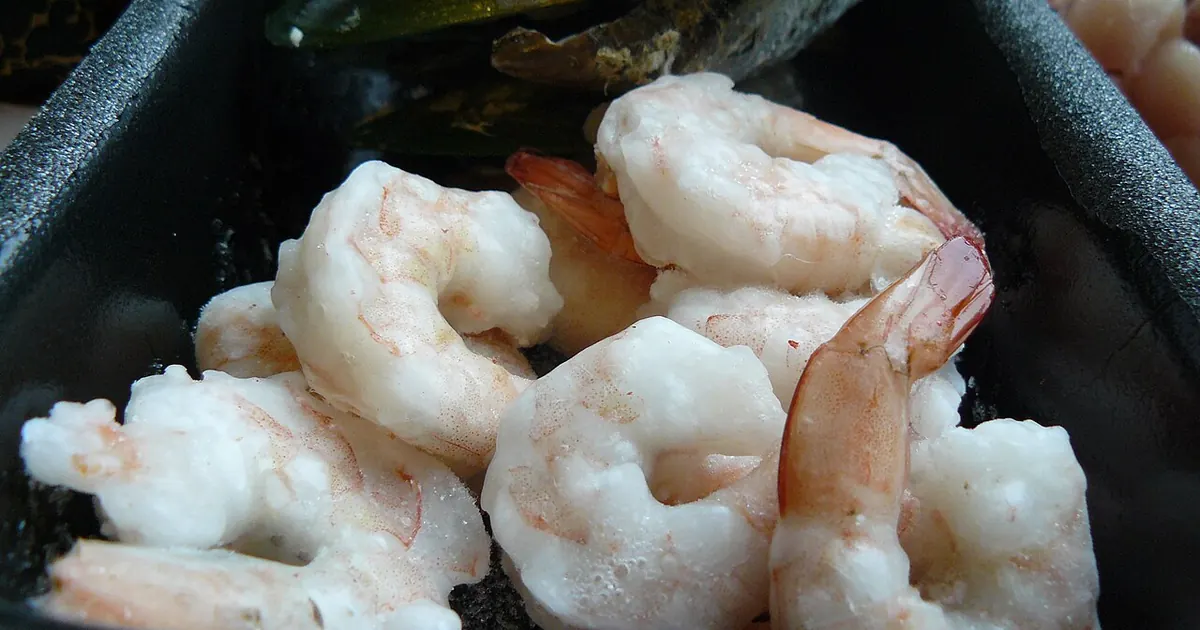
Request three frozen shrimp samples before a container, not one: a quote sample to check the product against your spec, a pre-production sample the plant must repeat and a shipment sample drawn from the actual lot with a sealed pair kept as reference. Each answers a different question, and mixing them is how a buyer approves a plant’s best carton and then receives its average one. This guide shows what to ask for at each stage, which tests to run, what a sample cannot prove and what the US and EU require when you import one.
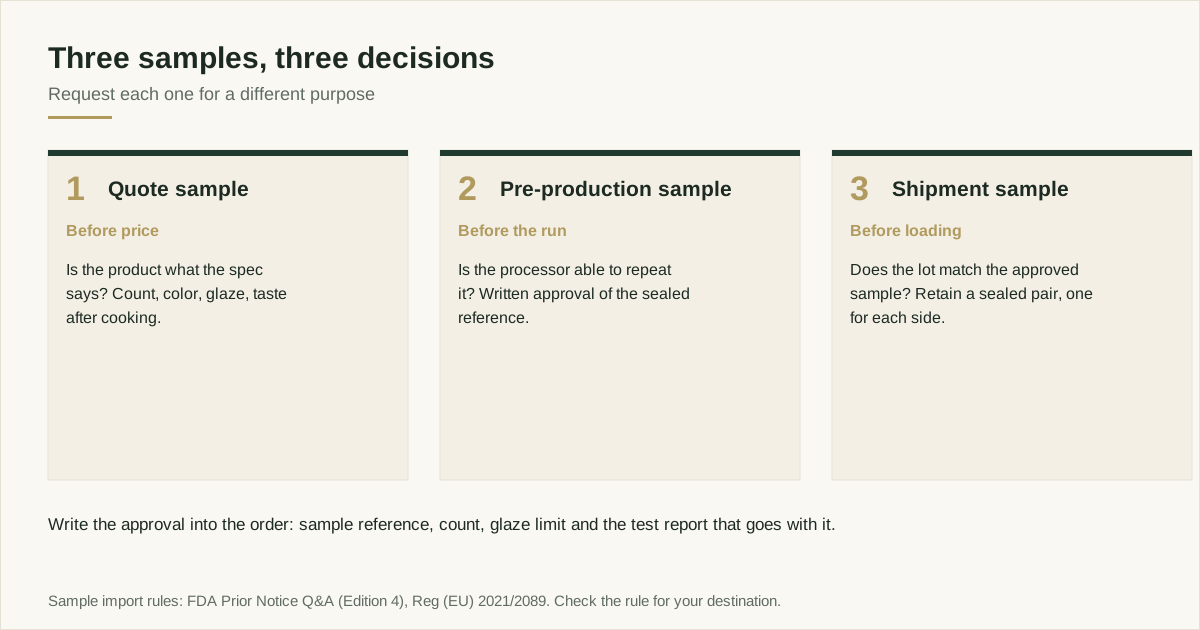
The three samples and what each decides
| Sample | When | Question it answers | Keep as reference |
|---|---|---|---|
| Quote sample | Before price | Does the product match the spec in count, color, form and taste after cooking | Optional |
| Pre-production sample | After price, before the run | Can the plant repeat it, and do both sides accept it in writing | One sealed unit with each side |
| Shipment sample | Before loading | Does the lot match the approved sample and the spec | Sealed pair from the lot |
The quote sample is often hand-picked. That is normal and does not hurt, as long as you treat it as the best the plant can make. The pre-production sample is the one that matters most, because the plant makes it on the line that will run your order and you approve it in writing. The shipment sample links the order to the container.
What to put in the sample request
- The spec the sample should meet: species, size count on deglazed weight, form, glaze percent and additive statement. Our guide to Vietnam shrimp size grades explains how a count is written.
- The pack: the same bag and carton you plan to order, so you see glaze, bag sealing and label as they will arrive.
- Production data: lot code, production date and the processing form on the carton, so the sample can be tied to a lot.
- A photograph of the unopened carton and the opened bag, with the carton code in frame.
- The test reports that exist for the lot: net weight and glaze, sulfite and antibiotic residue where relevant.
- How it ships: frozen at minus 18 degrees Celsius or colder, packed so that it does not thaw in transit.
Codex STAN 92 asks for storage at minus 18 degrees Celsius or colder, so a sample that arrives soft has told you about the courier, not the plant. Ask the forwarder whether they accept frozen food, how it is packed and whether a temperature logger fits in the box. If the sample arrives thawed, discard it and ask for another one: a refrozen sample fails the thaw and glaze tests for reasons that have nothing to do with the plant.
What to test on a sample
Run the same method on every sample so the numbers compare. Codex STAN 92 gives the method for net weight, thaw, count and defects, and our guide to shrimp pre-shipment inspection walks through it step by step. For a sample the key checks are:
- Glaze and net weight. Weigh frozen, deglaze under running water until no glaze is felt, drain and weigh again. The difference is the glaze, and the drained weight is the net. See glaze, net weight and yield.
- Count. Count the deglazed shrimp and divide by the deglazed weight, then compare with the grade in the spec.
- Defects. Check each thawed shrimp for dehydration, foreign matter, odor and discoloration. Our guide to frozen shrimp defects lists the soft shell and breakage that Codex does not score.
- Color and appearance. Compare raw and cooked color with the plant’s grade, as in our guide to shrimp color grades.
- Cook test. Where odor is in doubt, Codex prepares a 100 to 200 g portion for cooking, so a sample should be big enough to spare one.
- Lab tests. Sulfite as SO2, phosphate, antibiotic residue and microbiology, only for the claims in your spec. Our guides on sulfite in shrimp and antibiotic residue testing show what a report must state.
How big the sample should be
Codex STAN 92 defines the sample unit as the primary container, or for individually quick frozen shrimp at least a 1 kg portion of the unit. That is the smallest unit that can show glaze, count and defects with any meaning. A handful of shrimp cannot. If you plan three tests, such as the physical method, a lab test and a cook test, ask for enough units to run each one and keep a sealed unit unopened.
Ready to price this spec? Get matched with a shrimp supplier
What a sample cannot prove
A sample proves that the plant can make the product once. It does not prove that the lot you buy is the same. Codex judges a lot with a sampling plan at an acceptable quality level of 6.5, with the sample drawn from the lot, and says the average net weight of the sample units must not be below the declared weight. That is why the shipment sample and the sealed retain pair exist: they tie the container to the approved reference. Write into the order that the shipment is accepted when it matches the approved sample within stated tolerances for count, glaze, color and defects.
Who pays for samples
No public survey exists on what plants charge for samples or courier freight, so we give no figure. The common positions are free samples with the buyer paying the courier, or a charge that is credited against the first order. Agree this before the request, and ask the plant to state the sample’s lot and price per kilogram, so the sample is also a quote.
Importing a sample: US and EU
United States. FDA’s Prior Notice guidance says that food imported for use, storage or distribution in the US, including trade and quality assurance or quality control samples, generally needs prior notice. The exemptions are narrow: personal use food carried by an individual, a personal gift and food that is immediately exported, among others. FDA also states an enforcement discretion policy for samples imported for quality assurance, research or analysis, in quantities consistent with that purpose, where the entire sample is used up by the testing or destroyed afterwards. A sample that you cook and eat in a customer tasting may not meet that wording. Ask your customs broker to file prior notice for each sample shipment.
European Union. Delegated Regulation (EU) 2021/2089 amends Regulation 2019/2122 so that the authority of the destination Member State may exempt samples of products of animal origin for product analysis and quality testing, including organoleptic analysis, from checks at the border control post. The conditions include a prior authorisation issued to the operator responsible for the testing, an official document or a copy that travels with the samples, a certificate or declaration in the form set by Implementing Regulation (EU) 2020/2235 and origin in a third country on the EU list. The operator may not mix the samples with food for the market, must keep records of use and must dispose of the samples as animal by-products. The authority also sets the maximum quantity. If the authority does not authorise them, the samples are presented at a border control post. Ask your importer to apply for the authorisation before the plant ships.
These rules can change, and countries outside the US and EU have their own. Confirm with a customs broker for your destination.
Next step
Send the six lines of the sample request with your first message to the plants. Use the request form and we match you with up to 3 Vietnam processors. They reply within 24 business hours, and you can see which of them agree to a sealed retain pair and a written approval.
See also: the Codex CXS 92-1981 standard for quick frozen shrimp, explained.
Sources
- Codex Alimentarius, CODEX STAN 92-1981, quick frozen shrimps or prawns, sections 6, 7 and 9 and Annex A
- FDA, Prior Notice of Imported Food Questions and Answers, Edition 4 (October 2023)
- Commission Delegated Regulation (EU) 2021/2089 amending Delegated Regulation (EU) 2019/2122, Article 4 on samples (EUR-Lex)
Frequently asked questions
What frozen shrimp samples should I request from a processor?
Request three, each for a different decision. A quote sample shows whether the product matches your spec before you talk price. A pre-production sample shows that the plant can repeat it, and you approve it in writing. A shipment sample from the actual lot, with a sealed retain pair, shows that the container matches the approved one.
How big should a shrimp sample be?
Codex STAN 92 uses a sample unit of the primary container, or for individually quick frozen shrimp at least a 1 kg portion. A handful of pieces cannot show glaze, count or defects. Ask for at least one full unit per test you plan, and for a second unit that you keep sealed as a reference.
Do shrimp samples need FDA prior notice?
Usually yes. FDA's prior notice guidance says food imported for use in the US, including trade and quality assurance samples, needs prior notice unless an exemption applies. FDA also has an enforcement discretion policy for samples used only for quality assurance, research or analysis, in matching quantities, and used up or destroyed. Ask your customs broker.
Can a sample prove that a whole lot is good?
No. A sales sample is chosen by the plant and shows what the plant can make. A lot is judged on a sampling plan drawn from the lot, such as the Codex plan at an acceptable quality level of 6.5. Use the sample to approve the product and an inspection of the real lot to approve the shipment.
Ready to price this spec?
Send your species, size grade and certificate list. We match you with up to 3 Vietnam processors and reply within 24 business hours.
Get matched with a shrimp supplier