Guides / Specification
Sulfite in shrimp: the legal limits, how a lab tests it and what the label must say
November 2, 2026
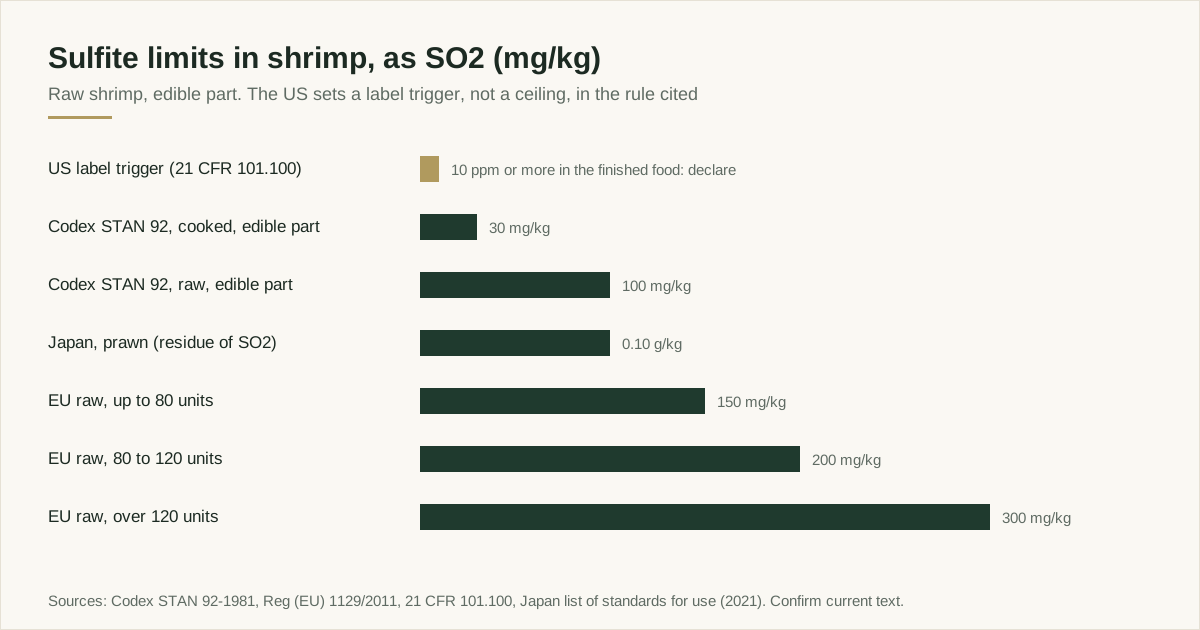
Sulfite in shrimp is the residue of a dip that stops black spot, and it is measured as sulfur dioxide (SO2) in mg/kg. The limit changes with the market: the EU annex allows 150 to 300 mg/kg for raw shrimp of the Penaeidae family depending on size, Codex STAN 92 allows 100 mg/kg raw and 30 mg/kg cooked in the edible part, Japan lists 0.10 g/kg for prawn, and the US sets a label trigger at 10 ppm rather than a ceiling. This guide shows the limits side by side, how labs test, why shell and head distort the result, and which lines to write into the spec.
Why sulfite is on the table at all
Plants dip or spray shrimp in a sulfite solution, most often sodium metabisulfite, because it blocks the enzyme behind melanosis. Our guide to melanosis and black spot explains the cause and the sulfite-free alternatives. The legal side is the topic here, because the same dip that keeps a head-on carton clean creates three buyer problems: a residue limit at the border, a label duty and customers whose own policy bans sulfite.
The limits attach to the product, not to the species. A black tiger lot and a vannamei lot of the same size and form face the same EU band, so the useful question to a processor is the treatment and the lab result, not the species.
Limits by market
| Market | Rule | Limit as SO2 | Base |
|---|---|---|---|
| Codex STAN 92-1981 | Sodium sulphite and metabisulphites, quick frozen shrimp | 100 mg/kg raw, 30 mg/kg cooked | Edible part |
| EU, raw | Annex II category 09.1.2, Penaeidae, Solenoceridae, Aristaeidae | 150 up to 80 units, 200 for 80 to 120 units, 300 above 120 units | Edible parts |
| EU, cooked | Annex II category 09.2 | 135, 180 and 270 for the same three bands | Edible parts |
| Japan | List of standards for use, prawn | 0.10 g/kg (100 mg/kg) residue | Residue of SO2 |
| US | 21 CFR 101.100(a)(4) | 10 ppm or more counts as present | Finished food |
Four notes on reading the table.
EU bands. The annex says “units” and does not state the base. Confirm with the destination lab or broker whether it reads the band as pieces per kilogram before you assume a size falls into the lower or higher limit. Smaller shrimp get the higher allowance.
EU footnotes. The annex expresses the limits as SO2 from all sources and says an SO2 content of not more than 10 mg/kg is not considered to be present. The limits apply to edible parts. Reg (EU) No 1129/2011 is the text I opened; the annex is amended from time to time, so check the consolidated version before you rely on a number.
Japan. The entry I read is “prawn, 0.10 g/kg” in the list of standards for use of additives published by the Japan Food Chemical Research Foundation, dated February 2021. The Japanese-language rule is the legal text, so ask your Japanese importer to confirm the current wording for shrimp.
US. I found no numeric US ceiling in the sources I opened. The rule that matters in the US is labelling: a sulfiting agent with no technical effect is insignificant only if no detectable amount is present, and a detectable amount is 10 ppm or more of sulfite in the finished food.
Edible part versus whole shrimp
The legal limits are written for the edible part. Sulfite does not spread evenly, and the shell and head hold much more than the tail meat. In one Italian study of frozen and thawed shrimps and prawns, measured by the Monier-Williams method, the shell-on and head-on samples averaged about 214 mg/kg, headless shell-on about 171 mg/kg and peeled and deveined about 113 mg/kg, and the inedible parts carried much higher levels than the whole shrimp. That is one retail study in one country and not a survey of Vietnam product, so treat the figures as an illustration of the gap, not as a benchmark.
The practical point is the test portion. A lab that grinds a whole shell-on shrimp reports a number that mixes shell with meat. Write into the spec that the sulfite result is on the edible portion, and ask the lab report to state the portion. Then a report from the plant and a report from your inspector compare on the same basis.
How labs test sulfite
The reference method is the optimized Monier-Williams distillation and titration, the AOAC-approved procedure for total SO2. Other methods are accepted when they give results similar to it. For a buyer, the method matters less than four details on the report:
- The sample: lot code, size, form and whether it was frozen or thawed.
- The portion: edible tail meat, or whole shrimp.
- The result as SO2 in mg/kg, with the limit of quantification.
- The date, the lab name and the method.
For routine lots, ask for a sulfite result per lot only on the products that were dipped. A plant that runs a sulfite-free line should still be able to explain its method and show at least one clean report. For a dispute, have an independent inspector draw sealed samples at the cold store, as described in our guide to shrimp pre-shipment inspection.
Ready to price this spec? Get matched with a shrimp supplier
What the label must say
United States. FDA Import Alert 99-21 covers food with undeclared added sulfiting agents and lists shrimp among the products. As read from the alert, a sulfite with a technical or functional effect is declared by its common or usual name. A non-functional sulfite at 10 ppm or more is declared in the ingredient list and may use the collective term “sulfiting agents”. Sulfites are not among the major food allergens, so they do not belong in a “Contains” statement. Undeclared sulfite over 10 ppm is a misbranding problem that relabelling can correct, which is cheaper than a refusal but still delays the lot.
European Union. Regulation (EU) No 1169/2011 lists “sulphur dioxide and sulphites at concentrations of more than 10 mg/kg or 10 mg/litre in terms of the total SO2” among the allergens that must be emphasised in the ingredient list. For prepacked shrimp, that means a lot with more than 10 mg/kg SO2 in the product as sold carries a sulphite declaration, even when the level is far below the 150 to 300 mg/kg limit.
Codex. Codex STAN 92 sends the rest of the labelling to the General Standard for the Labelling of Prepackaged Foods. Your market’s law decides the wording.
The consequence is simple. A plant that dips shrimp should print the sulfite declaration on the retail pack, and a buyer who sells under a “sulfite-free” claim needs a result below the detection or declaration threshold, not just a verbal assurance. Our guide to soaking, STPP and non-phosphate agents covers the parallel label question for phosphates.
What to write into the spec
- Anti-melanosis method allowed: sulfite, 4-hexylresorcinol, other or none.
- Sulfite limit as SO2 in mg/kg on the edible portion, and the market whose limit applies.
- Sulfite-free claim, if any, with the numeric threshold, for example below 10 mg/kg.
- Lab report per lot or per quarter, method named, portion named.
- Label text on the retail pack and the master carton for your market.
- Remedy if a lot exceeds the limit: replace, credit or reject.
Keep the same logic for other residue tests. Our guide to antibiotic residue testing for EU and US entry shows how to set the report requirements so they work with this one.
Additives are one step in our guide to importing frozen shrimp from Vietnam.
Next step
Put the six lines above into your next request. Send your spec through the request form and we match you with up to 3 Vietnam processors. They reply within 24 business hours, and you can see which of them name their anti-melanosis method and send a lab report without being pushed.
See also: the full shrimp lab test panel, as of October 2026.
Sources
- Commission Regulation (EU) No 1129/2011, Annex II food additives list, categories 09.1.2 and 09.2 (EUR-Lex)
- Regulation (EU) No 1169/2011 on food information, Annex II allergens (EUR-Lex)
- Codex Alimentarius, CODEX STAN 92-1981, quick frozen shrimps or prawns, section 4 food additives
- 21 CFR 101.100, food exempt from labeling, paragraph (a)(4) on sulfiting agents (eCFR)
- FDA Import Alert 99-21, detention of food with undeclared sulfiting agents
- Japan Food Chemical Research Foundation, standards for use of additives (February 2021 PDF)
- Food Allergy Research and Resource Program, sulfites in the USA (University of Nebraska)
- Italian Journal of Food Safety, analysis of the sulphite content in shrimps and prawns
Frequently asked questions
What is the maximum sulfite level allowed in shrimp?
It depends on the market. The EU annex lists 150 mg/kg for raw Penaeidae up to 80 units, 200 for 80 to 120 units and 300 above 120 units, measured as SO2 in the edible part. Codex STAN 92 lists 100 mg/kg raw and 30 mg/kg cooked. Japan lists 0.10 g/kg for prawn. Check the current text for your destination.
At what level does shrimp need a sulfite label in the US?
The FDA rule treats a sulfiting agent as present in a significant amount when the finished food has 10 ppm (10 mg/kg) or more of sulfite. At that level the sulfite must be declared on the label. Below 10 ppm and with no technical effect it counts as insignificant and need not be declared.
How is sulfite in shrimp measured?
Labs measure total SO2 with the optimized Monier-Williams distillation and titration method, which is the AOAC-approved reference. Ask the lab which part of the shrimp it tested, because shell and head carry far more sulfite than the edible tail meat and a whole-shrimp result overstates what the consumer eats.
Can I order sulfite-free shrimp from Vietnam?
Yes, you can write a sulfite-free requirement into the spec and ask the processor to name its anti-melanosis method. Sulfite-free lots use other agents or tighter handling, and the processor should back the claim with a lab report on the lot. Expect the plant to ask what threshold you mean, such as below 10 mg/kg.
Ready to price this spec?
Send your species, size grade and certificate list. We match you with up to 3 Vietnam processors and reply within 24 business hours.
Get matched with a shrimp supplier