Guides / Logistics
Importing shrimp from Vietnam into Korea and Australia: what rules to check and which specs to set
October 23, 2026
Korea and Australia both buy large volumes of shrimp, and both treat Vietnam as an important source. They also run import systems that differ sharply from the EU and US. Korea focuses on facility registration, inspection at the border and its own residue limits. Australia focuses on biosecurity, because its shrimp farmers have so far stayed free of several serious shrimp viruses.
This guide gives a buyer a checklist of what to confirm for each market and which specs to set. It does not replace advice from your importer or a licensed customs broker, since the rules change and details matter.
Two markets, two different questions
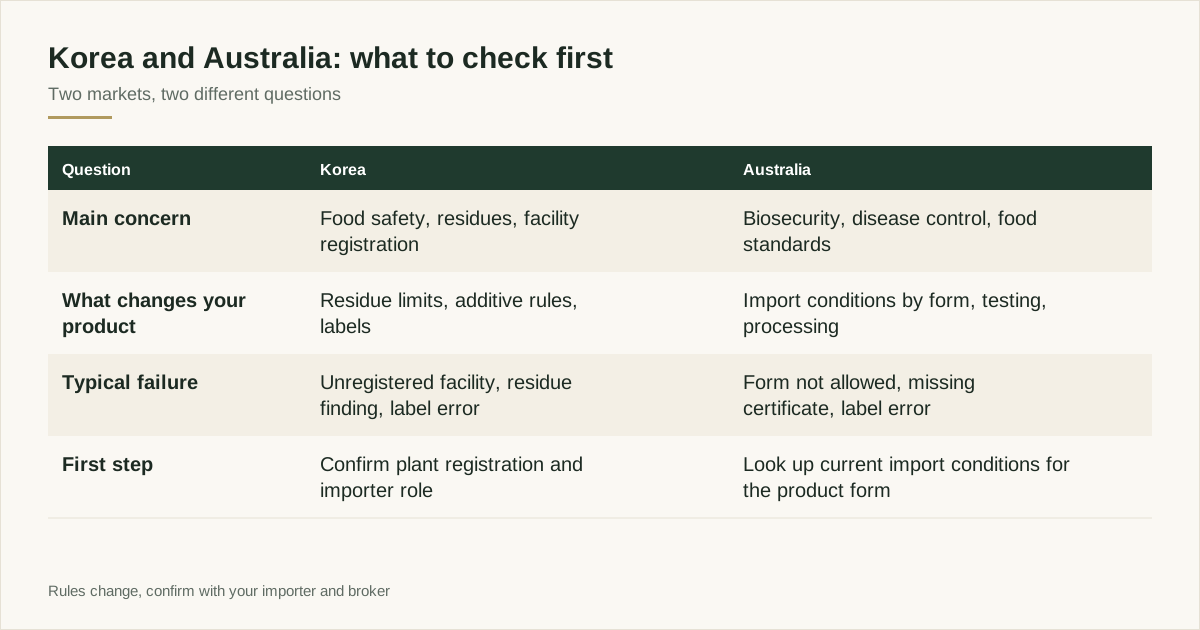
| Question | Korea | Australia |
|---|---|---|
| Main concern | Food safety, residues, facility registration | Biosecurity, disease control, food standards |
| Who decides | Food safety and fisheries quality authorities | Biosecurity authority and food standards bodies |
| What changes your product | Residue limits, additive rules, labels | Import conditions by form, testing, processing |
| Typical failure | Unregistered facility, residue finding, label error | Product form not allowed, missing certificate, label error |
Both markets also apply tariffs and trade agreement rules. Vietnam has trade agreements with each, and preferences depend on the certificate of origin and the tariff line. Ask your broker to confirm the current duty for your product.
Korea: what to check
Importer registration. The importer of record must be registered as an import business and must file an import declaration for each shipment. This is the importer’s task and not the plant’s, but the plant provides the documents.
Facility registration. Korea asks overseas manufacturers of food for export to register their facilities with its food safety authority. Confirm that your plant has done so, and ask for the registration number. If the plant is not registered, shipments can be stopped.
Border inspection. Imported fishery products go through inspection at the border, with documents checked and a share of lots sampled for residues, additives and microbiology. A lot with a prior violation faces more frequent testing. Ask the plant for its history of shipments to Korea.
Residues and additives. Korea sets its own maximum residue limits and an approved additive list. Substances banned in food animals are not tolerated, and additives not on the list cause rejection. Compare the plant’s additive list with the Korean list before you agree on treatment. Our guide on soaking, STPP and non-phosphate agents explains the labeling side.
Labels. Retail packs require Korean-language labels with the elements the rules specify, such as product name, origin, ingredients, manufacturer, importer, storage and expiry. A Korean sticker applied in the destination country is common, and some importers do it at their own facility. Decide who prints and applies it.
Health and origin documents. Typical shipments carry a health certificate, a certificate of origin and lot test results. Ask your importer which documents it needs for your product and in which form.
Korea: spec choices
Korean buyers use shrimp in retail packs, restaurant dishes, seafood soups and processed foods. Buyers often ask for cooked peeled shrimp, raw peeled and deveined shrimp and black tiger in larger sizes for premium use. Quality expectations on color and freshness are high, and Korean importers often inspect samples closely.
Write a spec with a tight size range, clear color chart, defined glaze and a net weight basis, as in our guide on glaze, net weight and yield. For cooked shrimp, add Listeria controls, as in the guide on cooked shrimp processing. Ask for residue test reports for each lot, with the analytes that Korea tests.
Australia: what to check
Biosecurity first. Australia restricts imports of raw prawns because they can carry viruses that threaten its prawn industry, such as white spot virus. The import conditions depend on the product. Uncooked prawns face conditions that can include testing of the product or restrictions on form, and cooked prawns follow a separate pathway with proof of cooking. The conditions have changed over time.
The conditions database. Australia publishes import conditions for each commodity in an online database run by its biosecurity authority. Look up your product there, read the current conditions and compare them with the plant’s capability. Ask the plant whether it has shipped the product to Australia and what certificates it supplied.
Certification and testing. Where testing is required, the sample, the laboratory and the certificate format matter. A test from a laboratory that the authority does not accept is worthless. Ask the plant which laboratory it uses and confirm with your importer that the authority accepts it.
Food standards and labels. Packs sold in Australia must meet the national food standards code and consumer law, including labeling of ingredients, allergens, net quantity and the country of origin. Origin labeling for seafood on retail packs follows a specific format. Importers usually apply or approve the artwork.
Inspection. Imported food is subject to inspection and sampling by the authority on a risk basis. Past findings raise the inspection rate for a product or a supplier.
Australia: spec choices
Because of the biosecurity rules, many Australian programmes use cooked shrimp or raw product in forms that the conditions allow. Buyers also look at peeled shrimp for retail and foodservice. Because the rules are product specific, build the spec around the pathway: choose the form first, confirm the conditions and then set sizes and treatment.
Our guide on shrimp processing forms explains how forms change cost and yield, and it helps to compare forms that the conditions allow. If you choose a cooked form, use the controls in the guide on cooked shrimp processing.
Timeline and planning for first shipments
A first shipment to a market with strict rules takes longer than a repeat shipment. Allow time for four steps. The importer confirms the current rules and the documents. The plant confirms its registration or its experience with the pathway. The two parties agree on labels and on the document pack. Then the plant produces the order and prepares the certificates.
For Korea, check the facility registration first, since an unregistered plant cannot ship at all. For Australia, check the import conditions first, since the product form may decide whether the shipment is possible. Build a calendar with a buffer for document review, and plan for at least one round of corrections. Our guide on payment terms and the first order timeline shows how deposits and balance payments can be tied to document milestones.
Ready to price this spec? Get matched with a shrimp supplier
Working with the importer and the broker
In both markets the importer of record carries the legal duty for the shipment. A good importer knows the current rules, files the declarations and handles contact with the authorities. A good customs broker checks the paperwork before the vessel sails and deals with port delays. Treat both as part of your team.
Ask the importer for a written checklist of documents, label requirements and test requirements for your product, and share it with the plant. Ask the broker to review draft documents before loading. Small errors such as a date format or a lot code mismatch are far cheaper to fix before the container leaves than after it arrives.
Keep copies of every document, test report and label proof for each shipment. If an authority asks a question months later, you will need them, and a plant that keeps its own records for the lot can support the answer.
Common documents for both markets
| Document | Why it is needed |
|---|---|
| Health certificate | Confirms the product meets the importing country’s health rules |
| Certificate of origin | Supports duty preference under trade agreements |
| Specification sheet | Defines product, treatment and quality |
| Lot test reports | Residues, microbiology and, where required, disease testing |
| Processing or cooking record | Needed when the pathway depends on cooking |
| Traceability record | Links the carton to the plant lot and the farm |
Ask the plant to prepare a document pack for the first shipment and review it with your importer before loading. A mismatch between a certificate and the carton code is a common reason for delay.
Risks and how to manage them
Three risks stand out. The first is rule change. Both markets update their rules, and an import condition that was valid at the time of order may have changed by arrival. Build a check into your order process, with a review of the conditions at order and before shipment.
The second is a document error. A wrong date, a missing stamp or a lot code that does not match the carton can lead to detention. Ask the plant for draft documents before loading and have the importer review them.
The third is cost of delay. Frozen shrimp held at a port accumulate storage charges, and a failed inspection means re-export or destruction. Define in the contract who pays in each case, as in the guide on antibiotic residue testing, which covers a border failure clause.
Cooked versus raw: how the choice changes risk
Many shipments to markets with strict rules run as cooked product, since cooking removes the biosecurity concern and moves the risk to food safety controls. A cooked line brings its own checks, such as Listeria controls and core temperature records, which the buyer must confirm. Raw product keeps more flexibility on use but brings more document and testing steps in markets such as Australia.
Weigh the two on cost, risk and customer need. If your customer cooks the shrimp anyway, raw may suit it better, as long as the pathway is open. If the customer wants a ready-to-eat item, cooked is the only choice. Ask the plant for its experience with each form for the destination, and for the number of shipments it has made in the last year.
What to write in the request
- Destination: Korea or Australia, and the importer’s role.
- Product and form, chosen against the current import conditions.
- Species, size grade, glaze and net weight basis.
- Treatment: additives allowed in the destination, and the label requirement.
- Plant status: registration for Korea or experience with Australian conditions.
- Documents: health certificate, certificate of origin, lot test reports and processing records.
- Label plan: language, sticker or printed pack and who applies it.
- Border failure terms: who pays for storage, re-testing and return.
For the US and EU gates, see our guide to importing frozen shrimp from Vietnam.
Next step
Ask your importer for the current conditions for your product, then write them into the request. Send your spec through the request form and we match you with up to 3 Vietnam processors that ship to Korea or Australia. They reply within 24 business hours, and you can ask each one for its registration details and a sample document pack.
Frequently asked questions
Can I import raw shrimp into Australia from Vietnam?
Raw prawns face biosecurity conditions aimed at keeping shrimp viruses out, and the conditions depend on the product form and the testing or processing the shrimp have gone through. Cooked product follows a different pathway. Always check the current import conditions in the Australian biosecurity database before you quote.
Does a Vietnam plant need to register to ship to Korea?
Korea asks foreign food manufacturers to register their facilities with its food safety authority, and the importer must register as an import business and declare each shipment. Plants that already ship to Korea usually know the process. Ask each plant whether it is registered and request the registration details.
Do Korea and Australia require local-language labels?
Retail packs need labels that follow local rules, including the local language in Korea and English with origin information in Australia. Foodservice and bulk packs have lighter requirements. Settle the label plan with your importer before artwork or printing.
Ready to price this spec?
Send your species, size grade and certificate list. We match you with up to 3 Vietnam processors and reply within 24 business hours.
Get matched with a shrimp supplier